


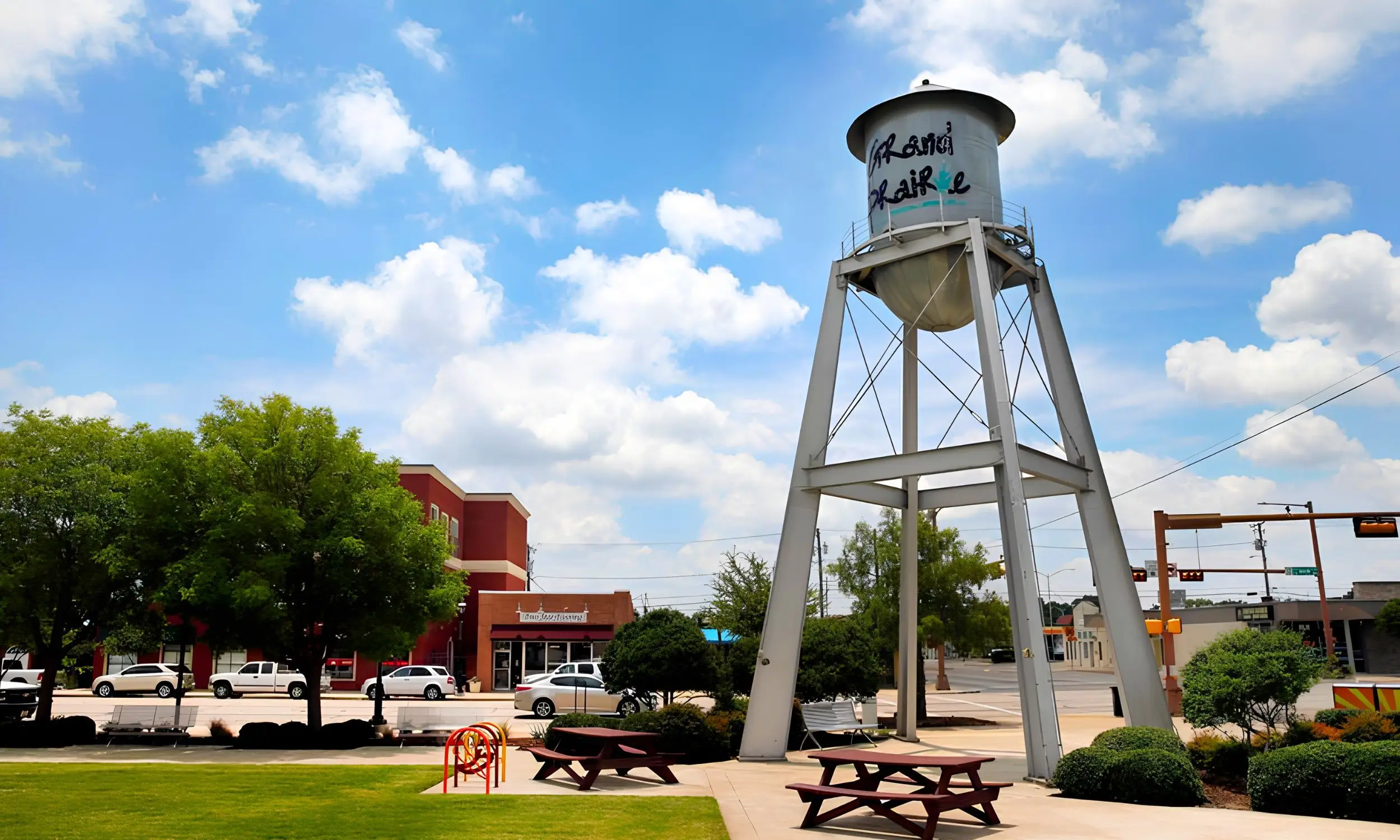
Dallas & Tarrant Counties · DFW Metroplex
Living in Grand Prairie, Texas
Where lake life, aerospace heritage, and city convenience meet, a diverse, family-forward city at the heart of DFW
Family Score = schools (35%) + safety (30%) + community (10%) + commute (15%) + market stability (10%), normalized 0–100 for readability · Affordability Score = price-to-income ratio + school quality per dollar + price vs. metro avg · Sub-scores on a 0–10 scale · Niche grades refreshed annually each fall
Your DFW Relocation Specialist
"Grand Prairie is the suburb I recommend when families want genuine value, real lake access, and a true geographic center, twenty-five minutes to Downtown Dallas, twenty-five minutes to Downtown Fort Worth, and ten minutes to DFW Airport. You get a diverse, working city with waterfront neighborhoods and a price point that still lets families build equity quickly."

Kristen Carpentier is a licensed Texas Realtor® (TREC #760457) and DFW family relocation specialist brokered by eXp Realty. A mom of four and wife of an Army Veteran, Kristen raised her family in DFW and knows North Texas suburbs from the inside out.
U.S. Census Bureau ACS 5-Year Estimates, 2023
Location & Commutes
Grand Prairie Sits at the Geographic Center of DFW
Grand Prairie occupies a rare position in the DFW Metroplex, wedged squarely between Dallas and Fort Worth along Highway 360 and SH-161, it offers one of the shortest access radii to either downtown of any city in the metro. That central location, combined with immediate proximity to DFW International Airport (less than 10 miles from most neighborhoods), makes it a natural landing spot for families on tight relocation timelines, frequent travelers, and anyone who works along the Highway 360 or SH-161 corridor.
The city spans a mix of terrain: rolling hills with cedar breaks in the west, the broad shoreline of Joe Pool Lake to the south, and established neighborhoods blending into the suburban fabric of Arlington, Irving, and Mansfield on all sides. Getting around is genuinely car-dependent, Grand Prairie has one of the more walkable downtown districts of any mid-sized DFW city (Walk Score 73), but most of its residential neighborhoods require a vehicle for daily errands. The Trinity Railway Express (TRE) runs along the northern edge of the city with a station at CentrePort/DFW Airport, giving some residents a car-free option for downtown Dallas or Fort Worth commutes.
Commute Times from Central Grand Prairie
Downtown Dallas
~18 miles · Via I-30 E, Financial District, Deep Ellum, Design District; main DFW office corridorDFW International Airport
~9 miles · Via SH-161 N, Under 15 min with no traffic; TRE CentrePort station also connects. One of the closest suburbs to the airport in DFW.Downtown Fort Worth
~24 miles · Via I-30 W, Cultural District, Sundance Square; NAS Fort Worth JRB is 20 min via I-820Las Colinas / Irving
~11 miles · Via SH-161 N, Exxon Mobil, Celanese, Nokia, Fluor, Kimberly-Clark campuses; 15–20 minPlano / Legacy West
~32 miles · Via I-30 E + I-635 N, Toyota HQ, Liberty Mutual, JPMorgan; 35–45 min depending on trafficFrisco / The Star
~42 miles · Via SH-161 N + DNT, Dallas Cowboys HQ, T-Mobile headquarters corridor; 45–55 minArlington (Mid-Cities)
~8 miles · Via I-20 W or SH-360 S, Six Flags, AT&T Stadium, UTA campus; General Motors Financial HQ nearbyTransit reality: Most Grand Prairie residents commute by car. The TRE CentrePort station at the northern tip of the city connects to Downtown Dallas (Union Station) and Downtown Fort Worth, but it's a 10–15 minute drive from most residential neighborhoods. DART and The T bus routes serve portions of the city with limited coverage. If car-free commuting is important to your family, the TRE connection is real but limited.
Schools & Education
Grand Prairie ISD: A-Rated District in a Diverse Community
Grand Prairie ISD serves roughly 28,000 students across 34 campuses, making it a mid-sized district by DFW standards. The district earned an A from the Texas Education Agency, a meaningful achievement that often surprises families who expect a diverse, urban-adjacent district to score lower. The A rating reflects strong accountability metrics including academic growth and progress for at-risk learners alongside traditional achievement scores.
For families with college-bound students, GPISD runs specialized pathways that stand out: the Grand Prairie Fine Arts Academy draws students from across the district for intensive arts training alongside rigorous academics; the Grand Prairie Collegiate Institute is a dual-enrollment early college high school where students can earn an associate degree while completing their diploma; and Dubiski Career High School offers 16 career-technical programs including aerospace technology, health science, and engineering. These magnet options give high-achieving students choices that would cost significantly more in a private school setting.
Multi-ISD note: Grand Prairie is a large city whose boundaries overlap several school districts. Most homes in the city fall within Grand Prairie ISD. However, some western and southwestern neighborhoods are zoned to Arlington ISD, Mansfield ISD, or Cedar Hill ISD. When buying or renting, always verify the exact school district for the specific address, the zip code alone is not a reliable guide in Grand Prairie.
Top-Rated Campuses
| Campus | Level | Type | Highlight |
|---|---|---|---|
| Grand Prairie Fine Arts Academy | K–8 / HS | Magnet | Visual/performing arts + rigorous academics |
| Grand Prairie Collegiate Institute | 9–12 | Early College HS | Earn associate degree while in high school |
| Dubiski Career High School | 9–12 | Career & Technical | 16 CTE pathways incl. aerospace & health science |
| South Grand Prairie HS | 9–12 | Comprehensive | IB programme candidate; strong athletics |
| Grand Prairie HS | 9–12 | Comprehensive | Flagship campus, diverse enrollment |
How Niche Grades Grand Prairie ISD
Kristen's school note: The specialized programs in GPISD, particularly the Collegiate Institute and Fine Arts Academy, are genuinely exceptional and often fly under the radar because Grand Prairie doesn't have the brand recognition of Frisco or Southlake. If you have a motivated student who would thrive in a dual-enrollment or arts pathway, these programs are worth a serious look. For families whose top priority is the traditional neighborhood elementary-through-high-school experience, verify the specific campus ratings for your target address and compare against Arlington ISD or Mansfield ISD if you're looking at the western portions of the city.
Best Neighborhoods
Where Families Are Buying in Grand Prairie
Grand Prairie's neighborhoods range from waterfront homes on Joe Pool Lake to established mid-century streets near the city core, with pockets of newer construction along the SH-360 corridor. The common thread: more home per dollar than comparable neighborhoods in Irving, Arlington, or Plano, and a genuine geographic advantage that puts most of DFW within a 30-minute drive.
Mira Lagos
$479K – $870K+
Master-planned community along Joe Pool Lake with resort-style amenities, pools, walking trails, a private lake access point, and a community clubhouse. One of Grand Prairie's most sought-after addresses for families. Newer construction mixed with established resale homes, all with generous lots by DFW standards.
No IDX saved search yet, ACTION: Kristen to create Lofty saved search for Mira Lagos
Lynn Creek Hills / Lynn Creek
$310K – $520K
Established neighborhood adjacent to Lynn Creek Park and Joe Pool Lake's northern shoreline. Families here have walkable access to Loyd Park's 11+ miles of trails and the Lynn Creek Marina. Mix of 1980s–2000s ranch and two-story homes on quiet cul-de-sacs. Excellent value for the lake-adjacent lifestyle.
No IDX saved search yet, ACTION: Kristen to create Lofty saved search for Lynn Creek Hills
Westchester / Westchester Estates
$260K – $420K
Well-established family neighborhood in the heart of Grand Prairie near SH-360. Tree-lined streets, brick ranch homes from the 1970s–1990s, and a community feel that's harder to find in newer developments. Close to the Epic Central Park campus and a short drive to the SH-161 corridor for commuters heading to Las Colinas or the airport.
No IDX saved search yet, ACTION: Kristen to create Lofty saved search for Westchester GP
Fish Creek / South Grand Prairie
$230K – $375K
The most affordable family-friendly pocket in Grand Prairie, offering solid brick homes on large lots in the southern portion of the city near Joe Pool Lake. Many homes here have been updated in recent years as buyers have discovered the value. Proximity to Mansfield ISD (for some addresses) adds school-zone flexibility.
No IDX saved search yet, ACTION: Kristen to create Lofty saved search for South GP / Fish Creek area
Prairie Lakes / New Construction Corridor
$340K – $550K
Newer master-planned and semi-custom construction along the SH-360 and I-20 corridors, with community pools, playgrounds, and HOA maintenance. These neighborhoods are attracting families priced out of Mansfield or Arlington who still want newer construction with modern finishes and energy-efficient builds.
No IDX saved search yet, ACTION: Kristen to create Lofty saved search for Prairie Lakes / new construction GP
Cost of Living
What Your Budget Buys in Grand Prairie vs. Where You're From
| Category | SF Bay Area | NY Metro | Chicago Suburbs | Grand Prairie, TX |
|---|---|---|---|---|
| Median Home Price | $1.3M–$1.8M | $650K–$1.1M | $420K–$650K | ~$353K |
| State Income Tax | 9.3%–13.3% | 4%–10.9% | 4.95% | $0 |
| Effective Property Tax | ~1.1% (Prop 13 cap) | ~1.8%–2.5% | ~2.0%–2.8% | ~2.25% |
| Typical Monthly Mortgage | $7,800–$11,000 | $3,900–$6,800 | $2,600–$4,100 | ~$2,100–$2,600 |
| Groceries (vs. national avg) | +18% | +22% | +5% | −3% |
| Gas (per gallon avg) | $4.60–$5.20 | $3.60–$4.00 | $3.30–$3.70 | ~$2.90–$3.20 |
The California math: A family earning $250,000 in California pays approximately $23,000 in state income tax. Moving to Texas, that $23,000 stays in your pocket every year, and in Grand Prairie specifically, the median home is priced $900K+ below a comparable Bay Area home. Even accounting for Grand Prairie's higher property tax rate vs. California's Prop 13 cap, most California families come out $30,000–$50,000 ahead annually in total housing + tax cost.
Property Tax Breakdown
Grand Prairie spans both Dallas County (east/central city) and Tarrant County (west/northwest portions). Both portions include the City of Grand Prairie at the same rate, but the county, hospital district, and community college rates differ. Most homes in Grand Prairie fall in the Dallas County portion (GPISD zone).
| Taxing Entity | Dallas County Portion | Tarrant County Portion |
|---|---|---|
| City of Grand Prairie | $0.6600 | $0.6600 |
| ISD (Grand Prairie / Arlington) | $1.0577 (GPISD) | $1.1035 (AISD) |
| County | $0.2155 (Dallas) | $0.1875 (Tarrant) |
| Hospital District | $0.2120 (Parkland) | $0.1825 (JPS / TCH) |
| Community College | $0.1056 (DCCCD) | $0.1123 (TCC) |
| Estimated Total per $100 | ~$2.251 | ~$2.246 |
Rates based on 2024 certified tax rolls from Dallas CAD and Tarrant CAD. Texas homestead exemption ($100,000 off appraised value for school district portion) applies if primary residence. Rates are set annually and may change. Verify with the applicable CAD before closing.
Jobs & Employment
Major Employers In and Around Grand Prairie
In Grand Prairie
- Lockheed Martin Aeronautics, ~4,000 employees; F-35 final assembly plant; one of the city's largest employers and anchors the aerospace economy
- Airbus Helicopters, North American HQ; helicopter manufacturing, MRO, and training operations
- Poly-America, Large polyethylene manufacturing operation; significant industrial employment
- Grand Prairie ISD, ~4,000 employees; one of the city's top institutional employers
- City of Grand Prairie, Municipal government, Epic Central campus operations, parks and recreation staff
- Amazon / Distribution, Multiple fulfillment and delivery centers along the SH-161 corridor serving the metro
Nearby Hubs (within 20–30 min)
- Las Colinas / Irving (~11 mi), Exxon Mobil, Nokia, Fluor, Celanese, Kimberly-Clark, La Quinta HQ; one of DFW's densest corporate corridors
- Arlington (~8 mi), GM Financial HQ, Envision Healthcare, University of Texas at Arlington, AT&T Stadium operations
- DFW Airport (~9 mi), American Airlines (~30,000 employees system-wide), airport operations, logistics, and hospitality
- Downtown Dallas (~18 mi), AT&T, Goldman Sachs, Comerica, Bank of America, major law and consulting firms
- Fort Worth (~24 mi), American Airlines HQ (Hurst/Fort Worth), BNSF Railway, Alcon, Texas Health Resources, NAS Fort Worth JRB
Family Life
What Life Actually Looks Like in Grand Prairie
Search Current Grand Prairie Listings →
Youth Sports & Athletics
Grand Prairie Athletics operates one of the more robust rec sports programs in mid-sized DFW, baseball, softball, soccer, basketball, tennis, and flag football leagues run year-round. The Epic Central park complex hosts tournament-quality fields. Local families also participate in NTPRD and regional travel leagues out of the Joe Pool / Lynn Creek corridor.
Joe Pool Lake & Outdoor Life
Joe Pool Lake, 7,500+ acres of Corps of Engineers water in Grand Prairie's backyard, is the defining lifestyle feature that draws many families to the city. Loyd Park offers 11+ miles of trails, boat ramps, fishing piers, and sandy beach areas. Lynn Creek Marina handles boat storage and launch. Families who sail, fish, kayak, or paddleboard are buying near the lake specifically for this access.
Shopping, Dining & Entertainment
The Epic Central and Main Street corridor gives the city a genuine urban amenity hub, restaurants, retail, and entertainment anchored by the Grand Prairie Premium Outlets (130+ stores). Live at the Epicenter is an outdoor amphitheater that draws touring acts. For weekly dining and groceries, the SH-161 and I-20 corridors are well-supplied with national chains and local spots. Dallas and Arlington's restaurant scenes are 20–25 minutes away for date nights.
Events & Community Culture
Grand Prairie has a genuinely active events calendar, Fourth of July fireworks at Epic Waters, the Epic Fest community celebration, weekly Farmers Market at the Main Street corridor, and annual holiday events at the lake. The city's diversity is its strength: Grand Prairie's population is one of the most ethnically diverse in all of DFW, and that shows up in the food, the cultural festivals, and the community feel. Families from all backgrounds report feeling at home here quickly.
Aerospace Heritage & Industrial Pride
Grand Prairie is not a bedroom suburb, it's a working city with a distinct identity rooted in aerospace and manufacturing. Lockheed Martin has built F-35s here since 2007, and Airbus Helicopters has operated its North American headquarters here for decades. That industrial backbone gives the city an economic stability that pure bedroom communities lack. Families employed in aerospace or defense find a built-in professional community that makes networking and career growth feel natural.
The "Value Play" Community Feel
Grand Prairie attracts a certain type of buyer: smart, practical, and slightly contrarian, someone who has done the math and realized they can get more home, more lake access, and a shorter airport commute than in any comparable DFW suburb at this price point. The community feel reflects that: neighbors are friendly, unpretentious, and genuinely invested in the city. It's not Southlake, and most residents here would tell you that's exactly the point.
Honest tradeoff: Grand Prairie is a city, not a suburb, and it shows. Traffic along SH-360 during morning and afternoon peak hours can rival anything in the metro. The city's industrial corridors along I-30 and I-20 aren't scenic. Some neighborhoods show their age and haven't seen the same reinvestment as comparable areas in Mansfield or Midlothian. The Niche crime grade of C+ reflects real crime patterns in parts of the city, particularly around older commercial corridors, neighborhood selection within Grand Prairie matters more here than in a smaller, more uniform suburb. Families who do their homework on the specific address and school zone consistently find what they came for; families who buy blindly sometimes end up in neighborhoods that don't match their expectations.
Getting Outside
Recreation, Walkability & City Amenities
Grand Prairie is car-dependent for most daily errands, there's no light rail serving residential areas, and DART/The T bus coverage is limited to major corridors. What the city compensates with is genuinely impressive: over 63 parks, 7,500 acres of lake, 11+ miles of lakeside trails, two major recreation centers, and one of the most ambitious park investments in mid-DFW in Epic Central. If outdoor recreation matters to your family, Grand Prairie delivers more square footage of parks and water access per dollar than almost any comparable DFW suburb.
Walkability & Transportation Scores
Walk Score and Bike Score from WalkScore.com. Walk Score 73 reflects the downtown core area; most residential neighborhoods score 20–40. Always check walkscore.com for a specific address before assuming walkability.
Parks, Trails & Green Space
Grand Prairie maintains 63+ parks covering approximately 2,000 acres of parkland and green space, a remarkable footprint for a city this size. The centerpiece is Joe Pool Lake and its surrounding Corps of Engineers land, which gives families access to waterfront recreation that most DFW suburbs can only dream about.
Epic Central Park
172-acre urban park anchoring the downtown corridor. Tournament baseball/softball fields, soccer complexes, splash pad, walking trails, and the Epic Waters Indoor Waterpark adjacent. The crown jewel of the city's park investment.
Loyd Park (Joe Pool Lake)
531 acres of Corps of Engineers parkland on Joe Pool Lake's western shore. 11+ miles of multi-use trails, boat ramps, fishing piers, equestrian trails, and camping sites. One of the best family outdoor destinations in mid-DFW.
Lynn Creek Park
The northern Joe Pool Lake access point from Grand Prairie, boat launch, swimming area, sandy beach, and picnic pavilions. Popular with families for summer weekend lake days; short drive from Lynn Creek neighborhood homes.
PlayGrand Adventures
Award-winning accessible inclusive playground, 35,000 sq ft of play equipment designed for children of all abilities. One of the largest inclusive playgrounds in Texas and a genuine community treasure.
Fish Creek Linear Park
A natural greenway corridor connecting neighborhoods in southern Grand Prairie. Walking and biking paths, creek overlooks, and native plantings, a quieter alternative to the larger park facilities for everyday neighborhood use.
Ripley Arnold Memorial Park & Others
Grand Prairie's 63-park system includes neighborhood pocket parks, tennis centers, disc golf courses, and sports complexes distributed throughout the city. Residents rarely have to drive more than a few minutes to reach a park.
City Recreation Centers & Facilities
| Facility | What's Inside | Notes |
|---|---|---|
| Epic Waters Indoor Waterpark | Waterslides, wave pool, lazy river, lap pool, splash pad | Membership and day-pass options; adjacent to Epic Central Park |
| Dooley Tennis Center | 10 lighted hard courts, lessons, leagues, clinics | Open to public; active adult leagues and youth programs |
| Grand Prairie Rec Center (EPIC) | Fitness center, group exercise, indoor gymnasium, multipurpose rooms | Main community rec facility; resident pricing available |
| Grand Prairie Public Library | Books, digital resources, maker space, programming | Main branch plus satellite locations across city |
| Lone Star Park (Racing) | Thoroughbred horse racing venue | Seasonal live racing; open to all ages for family outings |
Youth Sports & Organized Recreation
Grand Prairie's parks and recreation department runs one of the most comprehensive youth sports programs in mid-size DFW, with leagues and clinics running nearly year-round across multiple facilities.
Parent reality check: The Epic Central / Epic Waters complex is genuinely excellent, families who use it regularly say it rivals private club amenities at a fraction of the cost. The youth sports programs are well-organized and competitively priced vs. comparable cities. The one gap: travel sports families will still drive to fields in Mansfield, Arlington, or Southlake for tournaments, as Grand Prairie doesn't have the same density of private tournament facilities as some neighboring cities. The lake and trail system, however, is an everyday advantage that families with active kids use constantly.
Safety & Crime
Crime Rates and Safety in Grand Prairie
Grand Prairie's Niche crime grade of C+ reflects a city-wide average that includes higher-crime commercial corridors near I-30 and some older neighborhoods in the city core, but it's important to read past the headline number. The violent crime rate of approximately 2.2 per 1,000 residents is below the U.S. national average of roughly 4.0 per 1,000. Property crime rates are more elevated and closer to metro-DFW norms for cities of this size.
The practical guidance: neighborhood selection within Grand Prairie matters more than in smaller, more homogeneous suburbs. Family-oriented neighborhoods like Mira Lagos, Lynn Creek Hills, and the newer SH-360 corridor communities consistently score well on neighborhood-level safety tools. CrimeGrade.org shows these specific areas at B to B+ levels, meaningfully better than the city-wide C+ average. As with any large city, checking crime maps for a specific address (not just a zip code) before buying is standard practice.
Kristen's note: When families ask me about Grand Prairie safety, I always tell them the same thing: the city-wide Niche grade doesn't reflect the experience in the neighborhoods where I'm recommending they buy. Mira Lagos, Lynn Creek, and the newer SH-360 communities are genuinely family-safe. The older commercial corridors along I-30 pull down the city-wide number. Check NeighborhoodScout or CrimeGrade.org for the specific address you're considering, and ask your agent (me) for context on the micro-neighborhood.
Real Estate Market
Grand Prairie Housing Market Overview
In Grand Prairie, the heart of the market is the starter band: 66% of homes sold in the past year landed under $400K, where a median of about $312K buys roughly 1,776 square feet. About 2% of sales were $700K or more, so move-up and luxury buyers have real selection. Price per square foot climbs from about $176 at the entry level to $243 at the top, which is what you are paying for in larger lots, newer builds, and higher finish levels.
Median Sale Price
$354K
12-month rolling avg · single-family
Average Sale Price
$371K
12-month rolling avg · single-family
Price per Sq Ft
$172
Median · 12-month rolling
Sale to Original List
97.1%
12-month rolling · share of original list price
Days on Market
29 days
Median · 12-month rolling
Months Supply
3.4 mo.
Balanced market · 12-month
Active Inventory
321
Current active supply · single-family
Closed Sales
1,143
12-month total · single-family
A few more numbers worth knowing if you are weighing an offer in Grand Prairie. Over the trailing 12 months, single-family homes sold for a median of $354K and an average of $371K, which works out to about $172 per square foot. Homes here sold for roughly 97.1% of their original list price, which gives you a sense of how much room buyers have typically had to negotiate. As of the latest data, about 321 single-family homes were actively listed. These are NTREIS figures (the price metrics are 12-month rolling, inventory is current active supply), and your own price per square foot and negotiating room will vary by neighborhood, age of home, and finish level.
Search Current Grand Prairie Listings →
Source: NTREIS via suburb-profiles.json · 2025 · SFR only
Grand Prairie's housing market is one of the most active value plays in the DFW Metroplex. At a median SFR price around $353K, roughly $100K–$200K below comparable inventory in Mansfield, Irving, or Coppell, the city attracts first-time buyers, growing families, and investors simultaneously. Monthly supply of 3.5 months puts the market in balanced territory: sellers still have pricing power, but buyers aren't competing at the same frenzy level seen in 2021–2022. Median days on market around 30 days means well-priced homes move, but buyers have time for proper due diligence.
The lake-adjacent neighborhoods (Mira Lagos, Lynn Creek Hills) trade at a premium, expect $420K–$700K+ for homes with community lake access or waterfront lots. The newer SH-360 corridor communities run $340K–$550K. The city's affordable pockets in the older core and southern neighborhoods still offer entry-level buyers sub-$300K inventory, though those segments have tightened as buyers have discovered Grand Prairie's value proposition.
Honest Assessment
Grand Prairie Pros & Cons for Families
Pros
- Geographic center of DFW, equidistant to Dallas and Fort Worth, under 10 miles to DFW Airport; unmatched commute flexibility for dual-income households
- Joe Pool Lake and outdoor access, 7,500+ acres of lake, 11+ miles of trails, and a city parks system that punches well above its weight for a city this size
- Genuine value, $100K–$250K less than comparable homes in Irving, Coppell, or Mansfield, with the same metro access; one of the strongest equity-building opportunities left in North DFW
- Grand Prairie ISD TEA A rating, an A from TEA on a district this diverse and urban-adjacent is a real achievement; specialized programs (Collegiate Institute, Fine Arts Academy) add serious upside for motivated students
- Diversity and community inclusion, one of the most ethnically diverse cities in DFW, with an A+ Niche diversity grade; families from any background find their community quickly
- Epic Central / Epic Waters, a $100M+ parks investment that gives residents waterpark, tournament sports, and trail access that most similarly priced cities don't have
Cons
- C+ Niche crime grade, city-wide average includes higher-crime corridors; neighborhood selection within Grand Prairie matters more here than in smaller suburbs
- Multi-ISD complexity, city boundaries overlap GPISD, Arlington ISD, Mansfield ISD, and Cedar Hill ISD; buyers must verify the ISD for each specific address
- SH-360 and I-30 traffic, peak-hour congestion on the main north-south and east-west arteries is real; morning commute times can add 15–20 minutes vs. off-peak driving
- Industrial land use, the Lockheed/Airbus corridor and I-30 industrial areas aren't scenic, and some neighborhoods are close enough to industrial operations to notice
- No premier school-district cachet, GPISD's A rating is real but not well-known outside DFW; families who care about brand-name school district prestige (for college résumés, perceived property values) may prefer Frisco ISD or Carroll ISD
Frequently Asked Questions
What Families Ask About Moving to Grand Prairie
Yes, particularly for families who prioritize value, lake access, and a short DFW Airport commute. Grand Prairie's Niche grade for families is B+, and the city's parks system (63+ parks, Joe Pool Lake, Epic Central) gives families extraordinary outdoor amenities at a lower price point than comparable DFW suburbs. The multi-ISD complexity and higher city-wide crime average require more homework, but families who research specific neighborhoods consistently rate it highly.
Grand Prairie ISD earned an A from the Texas Education Agency, a strong rating for a diverse, urban-adjacent district. Niche gives the ISD an overall B with a B+ for families and A− for college prep. Standout programs include the Grand Prairie Collegiate Institute (dual-enrollment early college), Grand Prairie Fine Arts Academy, and Dubiski Career High School. Note: some homes in Grand Prairie are zoned to Arlington ISD, Mansfield ISD, or Cedar Hill ISD, always verify the ISD for a specific address.
The median single-family home in Grand Prairie is approximately $353K (NTREIS 2025). Homes near Joe Pool Lake and in master-planned communities like Mira Lagos run $420K–$870K+. Older established neighborhoods start in the $230K–$280K range. Days on market average around 30, and the market is balanced (3.5 months supply), meaning well-priced homes move steadily but buyers have time for proper inspections.
The combined effective rate is approximately 2.25% of appraised value, depending on which county your home falls in (Dallas or Tarrant). The City of Grand Prairie rate is $0.66 per $100 in both counties; the ISD rate is $1.0577 (GPISD, Dallas County) or $1.1035 (AISD, Tarrant County). Texas's $100,000 homestead exemption on the school district portion reduces the effective rate for primary residences. Verify rates with Dallas or Tarrant CAD for the specific address.
Grand Prairie is one of the closest suburbs to DFW International Airport, approximately 9 miles via SH-161 N, usually under 15 minutes with no traffic. The TRE CentrePort/DFW Airport station at the northern tip of the city also provides a rail connection for those who prefer not to drive. For families with frequent business travelers or those looking to minimize airport runs, Grand Prairie's proximity is a significant practical advantage over suburbs further north or east.
Grand Prairie's violent crime rate of approximately 2.2 per 1,000 residents is below the U.S. national average of ~4.0. Niche gives the city a C+ crime grade, a city-wide average that includes higher-crime commercial corridors along I-30. Family neighborhoods like Mira Lagos, Lynn Creek Hills, and the SH-360 corridor communities score B to B+ on CrimeGrade.org. Neighborhood selection matters more here than in smaller, more uniform suburbs, check crime maps for your specific target address before buying.
Top family neighborhoods include: Mira Lagos ($479K–$870K, lakefront master-planned community with resort amenities); Lynn Creek Hills ($310K–$520K, established neighborhood with trail and lake access); Westchester/Westchester Estates ($260K–$420K, tree-lined mid-range neighborhood near Epic Central); Prairie Lakes ($340K–$550K, newer construction with community pool); and Fish Creek/South GP ($230K–$375K, most affordable option near the lake). All fall primarily within GPISD.
Grand Prairie has exceptional parks for its price range, 63+ parks, approximately 2,000 acres of parkland, Joe Pool Lake (7,500 acres), and Loyd Park's 11+ miles of trails. Epic Central Park (172 acres) includes tournament fields, a splash pad, and walking trails adjacent to Epic Waters indoor waterpark. PlayGrand Adventures is one of the largest inclusive playgrounds in Texas. For families who want lake access, trail running, boating, and fishing in their backyard, Grand Prairie delivers better than any comparable DFW suburb at this price point.
Grand Prairie is cheaper than both and more centrally located. vs. Arlington: Grand Prairie's median price is $50K–$80K lower; Arlington has UT Arlington, AT&T Stadium entertainment, and slightly higher school ratings in some zones but less lake access. vs. Irving: Irving's Las Colinas corridor is more walkable and corporate-polished, but median home prices run $80K–$120K higher than Grand Prairie. Grand Prairie wins on value, lake access, and DFW Airport proximity; Arlington and Irving win on brand familiarity and upscale commercial amenities.
Kristen Carpentier is a licensed Texas Realtor® (TREC #760457) and DFW family relocation specialist who helps families moving from California, New York, Illinois, and other states find the right suburb, school zone, and home in North DFW. She specializes in matching families to the right city for their budget, lifestyle, and school needs. Contact her at Kristen@whymovetodallas.com or (602) 405-4115, or visit whymovetodallas.com to get started.
Free: The DFW Family Relocation Guide
Everything you need to plan your move, suburb comparison, school district breakdown, cost-of-living calculator, and a step-by-step relocation timeline. Built for families moving from out of state.
Ready to Make a Move?
Let's Find the Right Neighborhood for Your Family
Kristen specializes in helping families moving to DFW from out of state, she knows every neighborhood in Grand Prairie and can help you match school zones, commute needs, and budget to find the right home. No pressure, just honest guidance.
Also Exploring?
Compare Grand Prairie to Other DFW Suburbs
Side-by-Side Comparison
How Grand Prairie Stacks Up
Kristen Carpentier · Licensed Texas Realtor® · TREC Consumer Protection Notice · Information About Brokerage Services · TREC #760457 · Brokered by eXp Realty · 15950 Dallas Pkwy #400, Dallas, TX 75248
Not sure which suburb fits your family?
Rank the four levers that matter most — schools, commute, budget, lifestyle — and we'll narrow Dallas–Fort Worth down to your top three. Free, two minutes, no guesswork.
Try the Suburb Matcher →